
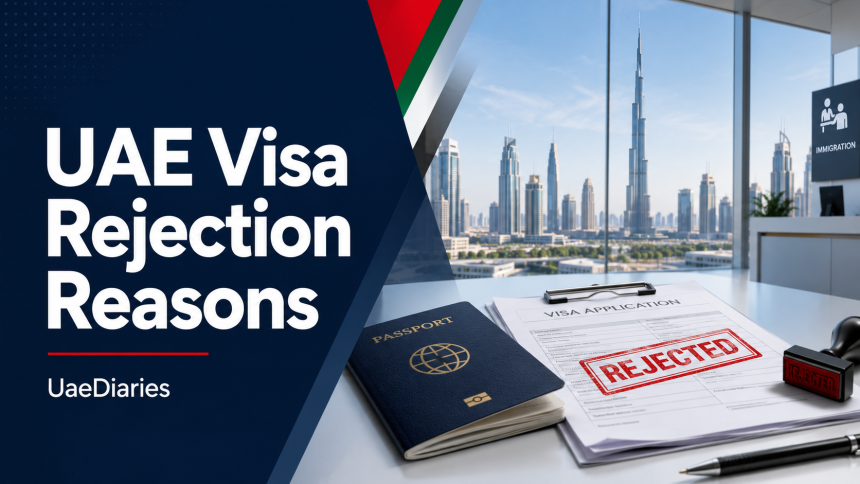
A UAE visa gets rejected for reasons like incomplete documents, health problems found in the medical test, security or criminal record issues, wrong sponsor details, or visa quota limits. If your visa is rejected, you can check the reason with your sponsor or typing center, improve the problem, and apply again.
What Does UAE Visa Rejection Mean?
UAE visa rejection means the visa application has been refused by the immigration authorities. This can happen at any moment, either before you enter the UAE or after your arrival if the authorities find a mistake with your paperwork. The UAE has severe measures in place to ensure the safety and order of the country. That’s why every application is scrutinized numerous times before it’s approved.
Two main authorities handle visa applications in the UAE:
- ICP (Federal Authority for Identity, Citizenship, Customs and Port Security)
- GDRFA (General Directorate of Residency and Foreigners Affairs)
Both authorities can reject a visa if the application does not meet their rules.
Common Reasons for UAE Visa Rejection
1. Incomplete or Incorrect Documents
This is the most typical reason for UAE visa rejection. Rejection can happen if you have missing pages, fuzzy scans, expired documents, or incorrect personal information. Even a little spelling mistake, like between your application form and your passport, can create problems.
Common document issues include:
- Passport with less than six months’ validity
- Photo that does not meet UAE photo rules
- Missing educational certificates for skilled jobs
- Mismatched name spelling across documents
2. Employment Visa Rejection in UAE
An employment visa rejection in the UAE normally happens because of a problem with the job offer, employer or the worker’s background. Employer mistakes can potentially impact the worker as the corporation has to sponsor the visa.
UAE employment visa rejection reasons often include:
- The employer’s company license is expired or has issues
- The job title does not match the worker’s qualifications
- The worker already has an active visa under another employer
- Incorrect labor contract details
- The employer has not paid required fees or fines
- Quota limits for foreign workers in that job category
If you are asking why a visa was rejected in the UAE for a job offer, checking these employer-side details is a good first step.
3. UAE Visa Rejected for Security Reasons
One of the more serious forms is an uae visa rejected for security reasons case. This happens when the applicant’s name appears on a security watchlist, when they have a legal history in the UAE or in another country, or when they raise an alert during background checks.
Security-related rejections can include:
- Previous deportation from the UAE
- Overstay history in the UAE or other Gulf countries
- Name similarity to a person on a security list
- Past visa fraud or fake document use
- Involvement in illegal work history
These cases are harder to reverse and often need legal help or a formal clarification request.
Read Also: Dubai Work Visa
4. UAE Visa Rejection for Medical Reasons
A UAE visa rejection for medical reasons case happens after the mandatory medical fitness test, which is required for most work and residence visas. The UAE tests for certain infectious diseases and health conditions as part of public health screening.
Health-related rejection triggers include:
- Positive test for HIV
- Active tuberculosis
- Positive test for Hepatitis B or C
- Certain other infectious diseases
Pregnancy is not a valid ground for rejection of a medical visa for most visa types under UAE Health Screening guidelines. If you think you were mistakenly disqualified on medical grounds, you may ask the medical authority to retest you.
5. Criminal Record or Past Violations
A visa may be refused if the applicant has a criminal record in the UAE or in the home country of the applicant. This also applies to those who have previously violated UAE immigration restrictions such as working without a permit or overstaying their visa expiry date.
6. Visa Quota Limits
The UAE government have annual quotas for specific employment categories and nationalities. If a certain quota for a role or industry is filled, subsequent applications may be refused until the next quota cycle starts.
7. Sponsor or Company Issues
Most visas require a sponsor (employer, family member or corporation); therefore, if there is any problem on the sponsor’s side, then this can lead to rejection. This could be outstanding government fines, an inactive trade license or the sponsor exceeding their limit of visas.
Read Also: UAE Family Visa 2026
How to Check Why Your Visa Was Rejected in UAE
If you are wondering why your visa was rejected in the UAE, here is how to find the exact reason:
- Check the rejection notice – ICP or GDRFA usually issues a rejection code or short reason
- Ask your typing center – the center that submitted your application can explain the rejection code
- Contact your sponsor or employer – for job-related visas, the employer’s PRO (Public Relations Officer) can check the company file
- Visit the ICP or GDRFA website – you can track application status using your application number
Read Also: UAE Golden Visa 2026
What to Do If Your UAE Visa Is Rejected
If you are asking what to do if your UAE visa is rejected, follow these steps:
- Get the exact rejection reason from the typing center or authority
- Fix the specific problem — correct documents, retest for medical issues, or resolve employer-side fines
- Ask about an appeal — some rejections allow a formal appeal within a set time limit
- Reapply once the issue is resolved — most people can submit a fresh application after fixing the problem
- Get legal advice for security-related rejections — a UAE immigration lawyer can help clarify complex cases
Read Also: Dubai Visit Visa Extension
Can You Reapply After a UAE Visa Rejection?
Yes, in most cases, you can reapply after a UAE visa rejection. Document mistakes and employer-side difficulties can often be fixed swiftly, allowing for a new application within a few days. Medical rejections can be followed by testing again after a waiting period set by the health authorities. Security-related rejections take longer to address and may require more paperwork or legal support before a fresh application is accepted.
How to Avoid Visa Rejection in UAE
- Verify all documents before submitting
- Ensure that your passport is valid for at least six months
- Make sure your employer has a current and active trade license
- Undergo the medical examination in an approved center
- Be honest about any prior visa history in the UAE
- Use a licensed typing center or PRO service to avoid errors on the forms
Read Also: UAE Transit Visa 2026
Final Thoughts
UAE visa rejection isn’t necessarily the end of the road. In most situations, it comes down to small mistakes, workplace concerns or medical results that may either be fixed or disputed. The first step to solving the problem and moving on to a fresh, successful application is to know exactly why you were rejected.